Talking With Voices II

Talking With Voices (TwV) is a new form of talking therapy that comes from the work of the International Hearing Voices Movement. It is based on the idea that what voices say may reflect real-life conflicts and difficulties; so, for example, a person who had a time in their life when they felt very afraid may later hear voices which are angry and threatening. In this way, the voices can be understood as drawing attention to problems that may have happened in the past or be reoccurring in the present.
TwV involves a therapist ‘talking’ to the voice by asking it questions. The person then listens to the responses and repeats them out loud to the therapist. Over time, the therapist learns more about the voices in order to support the voice-hearer to develop a more peaceful relationship with them. In addition, the therapist and voice-hearer work together to try and understand how the voices may relate to certain difficulties in the person’s life. It is hoped that understanding more about the links between voices and negative life events and emotions can provide useful information for helping people make sense of their experiences. In the long-term, this may also be helpful for learning new ways to cope with the voices and become less distressed by them.
We have already run a small study amongst 50 voice-hearers which showed that TwV was seen as an acceptable form of support and could be delivered in the NHS. We now want to run a much larger trial to understand whether TwV is an effective therapy and, if so, what aspects of it may be particularly helpful for people.
WHO ARE WE LOOKING FOR?
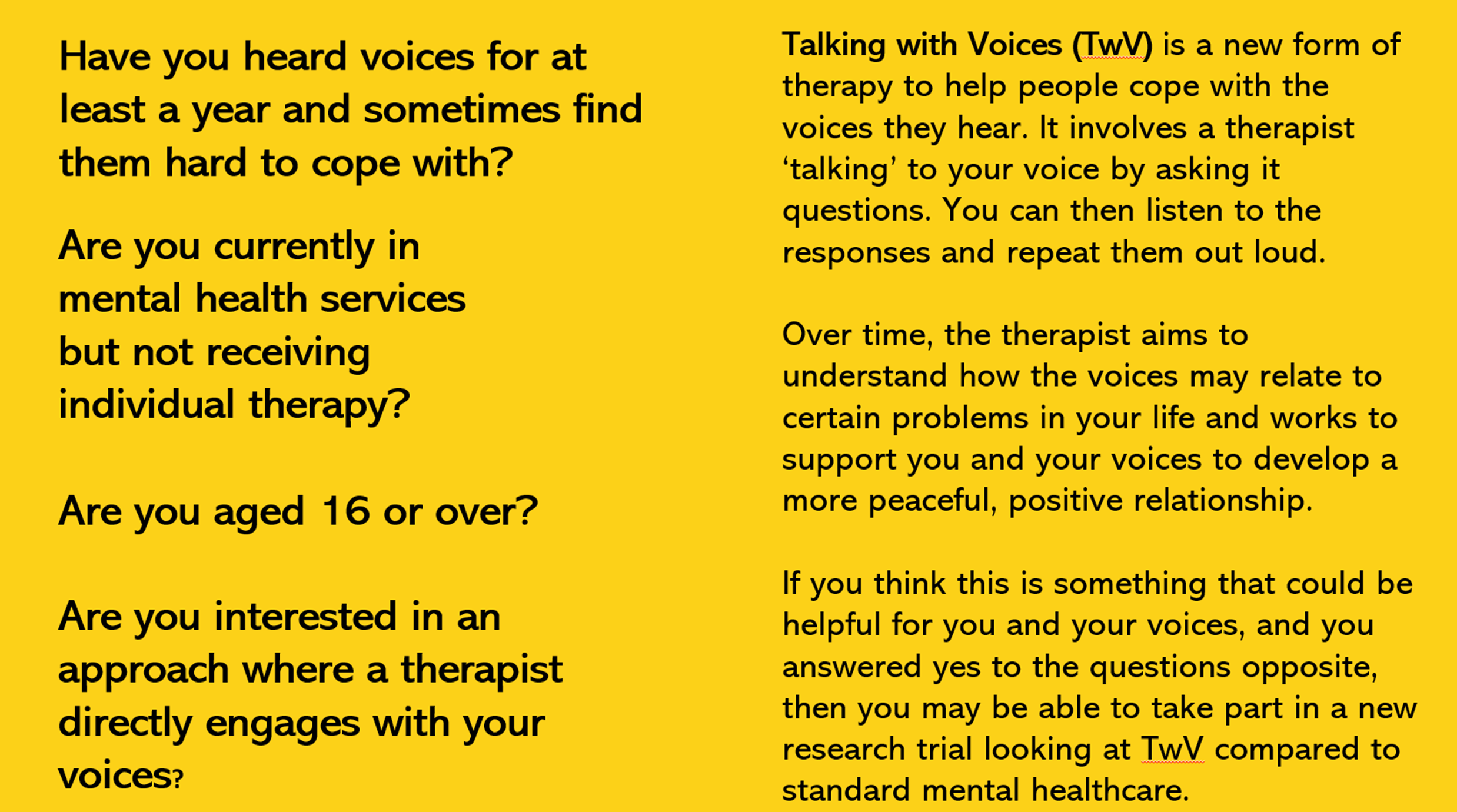
We are looking for people who:
- Are aged 16 and over
- Have heard voices for a minimum of one year
- Are currently distressed by hearing voices
- Have been in contact with mental health services for at least 6 months
- Are actively help seeking in relation to distressing voices
- Are not currently receiving any structured, one-to-one psychological therapy
- Are willing and able for a therapist to engage with their voices using dialoguing techniques
RESEARCH TEAM:
Chief Investigator: Eleanor Longden
Co-chief Investigator: Tony Morrison
Trial Manager: Alison Branitsky
TRIAL PROGRESS:
The trial has now finished recruitment, achieving a total of 309 participants (more than our target of 296), so we are no longer taking referrals.
All follow-up assessments have finished, and the data has been locked and analysed.
Please keep visiting this page, which will provide a link to the trial results when they become available.
Click here for the trial protocol: https://doi.org/10.1186/s13063-025-09018-y
Click here for the trial registration: https://doi.org/10.1186/ISRCTN15897915